
When do you need to disclose AI-generated marketing content?
Author

Last modified: 25 August 2026
Sources checked on 25 August 2026
Using AI in marketing does not, by itself, usually mean you have to label the finished material as AI-generated.
Disclosure is particularly important when AI creates or substantially alters realistic images, video or audio that people could mistake for authentic material. It also matters for certain AI-generated texts on issues of public interest when there’s no meaningful human oversight.
Use that distinction when you plan an ad, social post, website or sales material.
AI can help you plan campaigns, brainstorm ideas, draft a post, edit copy or try different headlines. Those tasks generally carry a lower risk of misleading people.
Risk rises when people could mistake an invented project, fictional customer, cloned voice, realistic avatar or simulated before-and-after result for the real thing. The same applies if an image shows a feature the product doesn’t have.
Does every piece of AI-assisted content need a label?
Ordinary marketing copy, such as a draft newsletter, post, ad or headline, usually doesn’t need a label solely because you used AI. Have someone check facts, prices, claims and offer details before publication.
A blanket rule that says “We used AI, so we must label it” can be confusing in practice. Using AI to edit text and using it to generate a photorealistic model for an ad call for different decisions.
For example, ChatGPT might draft three versions of a LinkedIn post. A marketer can check the facts, edit the copy to suit the brand and approve it. That’s a routine editorial use of AI.
A generated photo of a “happy customer” carries a different risk if people could take it for a real customer using the product.
When does AI content need a disclosure?
Pay particular attention to realistic images, video and audio created or substantially altered with AI. A viewer or listener could mistake a depiction of a person, place, event, statement or product for authentic material.
Under the EU AI Act, a deepfake can involve images, audio or video that resemble an existing person, object, place, entity or event and could falsely appear authentic. The definition covers more than face swaps.
Ask yourself this before publishing.
Could an ordinary viewer believe that the person, scene, project, place, statement or product feature is real?
This matters in online campaigns where an image, video or sound clip might be someone’s first encounter with your brand.
If it could pass for authentic material, check whether you need a disclosure. Redesign the ad if it gives the wrong impression of what actually exists.
Which marketing materials usually need a label?
Assess the finished material and where it will appear.
Routine AI assistance generally needs no label. For realistic generated material, check the applicable legal and platform rules and whether your audience could mistake it for authentic footage, audio or imagery.
| Scenario | Disclose AI use? | What to do |
|---|---|---|
| ChatGPT drafts a post, marketing email or ad | Usually not. | Check facts, offer details, prices, claims and tone. |
| AI shortens copy, edits the style or suggests headlines | Usually not. | Treat it as editorial assistance and review the result before publishing. |
| AI helps plan a campaign, call to action or landing page | Usually not. | AI helped with planning. The finished material contains no realistic synthetic media. |
| AI generates a photorealistic person for an ad | Label it as a precaution | Make clear that the person is AI-generated. Avoid implying that they are an actual customer, employee or expert. |
| AI creates a realistic image of a hotel, office, clinic, shop or restaurant | Yes, if it could be mistaken for a real place | Label it as a concept if the place doesn’t exist. |
| AI visualises a proposed interior, product or building | Yes, if the image could be mistaken for the finished result | Use wording such as “AI-generated concept visualisation”. |
| AI digitally furnishes a photo of a real empty flat | Often yes | The edit may significantly change how the actual flat appears. |
| AI creates a fictional before-and-after result | Use only as an illustration | Describe it clearly as a simulation or concept. |
| AI writes a fake customer review | Keep it out of customer reviews | Fake reviews can mislead consumers, harm trust and expose the business to legal consequences. |
| AI clones a real person’s voice | Disclose it and check consent | Check whether you have the right to use the person’s voice or likeness and whether other personality rights apply. |
| AI creates a realistic avatar to present an ad | Yes | “Character and voice generated using AI.” |
| AI generates video captions automatically | Usually not. | Captions are generally a production aid. |
| AI sharpens footage, removes noise or improves recording quality | Usually not. | This assumes the edit leaves the substance of the recording intact. |
Does a post written with ChatGPT need a label?
An ordinary post, service description, newsletter or version of an ad generally doesn’t need a label just because ChatGPT or another AI tool helped draft it.
Have a person verify facts, dates, prices, terms, promises, sources, quotes and claims about past projects before publishing.
The publisher remains responsible for what an ad claims. Check whether the tool invented a promotion, made up a product feature or credited the company with work it never did.
For internal review, keep three categories of AI use separate.
| Internal category | What it means | Example |
|---|---|---|
| AI-assisted | AI assisted with the work and produced no realistic synthetic media. | Drafting copy, editing text or brainstorming campaigns |
| AI-modified | AI substantially altered existing material. | AI adds furniture to a photo of an actual room |
| AI-generated | AI created a significant element from scratch. | A photorealistic model, scene, voice-over or avatar |
Keep this record internally. It helps the team trace what was created, who approved it and which material may need a disclosure.
What can count as a deepfake in marketing?
Face swaps are one example. A realistic depiction of a person, place, event, statement, product or result can be risky if people could reasonably take it for the real thing. Consider where you’re publishing it and what the audience expects, as well as how it was made.
Examples that call for a closer look
- a realistic AI-generated “customer” in a product ad
- an avatar that looks like a real person,
- a synthetic voice-over that sounds like a real person
- an image presented as a photo of the company’s premises when those premises don’t exist
- an architectural visualisation presented as a photograph of a completed building
- a fictional case study presented as real client work
- a simulated before-and-after result presented as evidence of what a service achieves
Risk is greatest when an ad uses synthetic material as proof of a claim.
A label cannot correct a misleading claim. Change or withdraw ads that depict fabricated results, fake reviews, nonexistent places or features customers won’t receive.
How should you label AI content?
Make the disclosure clear and accessible when someone first encounters the material. Place it where people will see or hear it as they view the ad, rather than burying it in the terms or site footer.
The AI Act allows flexibility in the wording. Choose plain language the audience can understand.
Examples of disclosure wording
- “Image generated using AI.”
- “Image generated using AI.”
- “Video generated using AI.”
- “Part of this material was edited using AI.”
- “This material includes AI-generated elements.”
- “AI-generated concept visualisation of a proposed project.”
- “Synthetic voice.”
- “Character and voice generated using AI.”
Place the disclosure where it works for the format.
| Format | Where to put the disclosure |
|---|---|
| Image | On the image itself or immediately beside it. |
| Video | Show it at the start or when the content first appears. Leave it visible long enough to read. |
| Audio | Make the disclosure audible to listeners. |
| Website | Place it beside the relevant material where people will see it. |
| Advertising / social media | Use the platform’s disclosure tool and check that viewers or listeners can actually see or hear the label. |
The European Commission provides icons for labelling AI-generated content. Their use is voluntary. Pairing an icon with plain text makes it easier to understand. An icon alone doesn’t establish compliance.
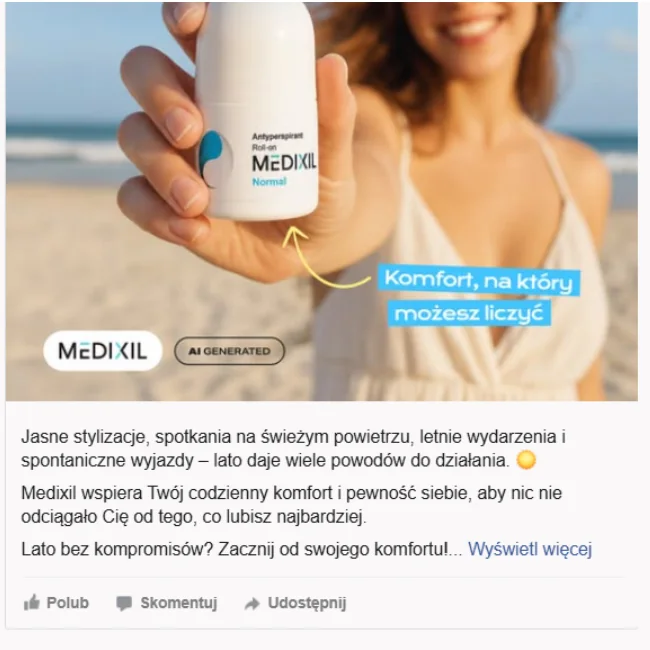
Is the platform’s label enough?
A checkbox, label or automatic disclosure can help. You still need to assess the material yourself. A platform might place its label somewhere different from where a particular disclosure is required, or use a labelling policy with a different scope.
Meta says ads on Facebook and Instagram can carry labels when generative AI creates or substantially alters the material. The label may appear beside “Sponsored” or in the three-dot menu, depending on the content and how it was created.
Google introduced AI labelling options in July 2026, including labels added directly to ad creative and settings in Google Ads and related products. Advertisers still need to check which legal obligations apply.
YouTube requires disclosure for realistic content that has been generated or meaningfully altered. Examples include footage that makes a real person appear to say or do something they didn’t, and realistic scenes that never happened. Minor cosmetic edits and routine production help such as captions or script ideas generally need no disclosure.
TikTok requires labels for AI-generated content containing realistic images, audio or video. It can also label some content automatically.
Use the relevant platform setting and check the live format. For realistic material, people should see or hear the disclosure before taking it for authentic content.
When is an AI label insufficient?
An AI label doesn’t make a misleading ad lawful. Fix or remove ads that rely on fictional projects, invented reviews, fabricated outcomes or inaccurate depictions of the product or premises.
Keep the following out of claims about real work or customers.
- AI-generated customer reviews
- invented case studies
- AI-generated people presented as customers
- imagined projects presented as completed work
- fabricated before-and-after results
- invented campaign results
- fake certificates, awards or testimonials
- endorsements an expert never gave
- product images showing unavailable features
Polish consumer protection rules also apply. Poland’s Office of Competition and Consumer Protection warns against claiming that reviews come from real customers without taking steps to verify them. Fake reviews can mislead shoppers.
Describe concept work accurately. Use “visualisation”, “concept”, “simulation” or “sample interior” where those terms fit.
What if the material uses a real person’s likeness or voice?
Rules on consent, likeness, voice and personality rights still apply alongside the AI Act. Take particular care with face swaps, voice cloning, fabricated statements, changes to someone’s appearance and avatars or scenes based on an identifiable person.
Permission to use a photo in a campaign does not automatically cover synthetic alterations.
For an AI-assisted production, agree on the following in advance.
- which changes are permitted
- where the material may appear
- how long it may be published
- which territories are covered
- whether the person’s voice, face, body or avatar may be used
- how the finished material will be labelled
For campaigns featuring public figures, employees, customers, influencers or experts, consider asking a lawyer to review the scope of consent before production.
What should you check before publishing AI content?
Find out how AI contributed, which images, video or audio it created or altered and whether the result could pass for authentic. Check any claims about products, customers, places or results and the relevant platform’s own disclosure rules.
A review checklist for marketing teams
- Was AI used only to assist the team?
Brainstorming, research, planning and routine copy editing generally don’t require a label solely because AI helped. - Did AI create or substantially alter images, video or audio?
If so, assess how realistic the finished material looks or sounds. - Could someone reasonably mistake it for authentic material?
If so, check the disclosure rules for that material and platform. - Does the material make a claim about a real product, place, customer, project or result?
If it gives the wrong impression, correct the material itself. A label alone won’t fix it.
When should a lawyer review the material?
Consider legal review when a campaign uses a real person’s voice or likeness, deals with health, finance, politics, safety or public affairs, or involves comparative ads, personal data, influencers or claims that could influence a purchase.
Evostudio can help plan communications, websites, campaigns, SEO and GEO. For advice on specific legal obligations, speak to a qualified lawyer.
Give your marketing team a review process for AI content and a way to raise legal questions with qualified counsel.
How does AI-assisted marketing affect SEO, GEO and trust?
AI-assisted content can support online visibility when it’s accurate, well organised, current and verifiable. For GEO, describe the business and its services clearly and give people, search engines and AI tools evidence they can check.
Focus on three practices.
- Explain what you do, whom you help, when the service fits, how the work proceeds and what terms apply.
- Use AI to explore creative ideas. Support marketing claims with real case studies, customer feedback, project photos and data.
- Agree on who approves materials, when they need a label, where to record AI use and when to seek legal advice.
A consistent process helps earn trust. Credibility supports your work in SEO, advertising, social media and AI search.
A rule of thumb for marketers
Routine AI assistance usually needs no label when the finished material doesn’t present anything fabricated as real.
Realistic images, audio or video created or substantially changed with AI generally call for a closer look and may need a label.
Present simulations and concepts as such. Claims about real products, projects, reviews and results need real evidence.
Marketing teams and business owners can use this distinction to assess when AI could give people a false impression of authenticity.
Combine AI tools with an editorial process and a strategy that connects your website, campaigns, SEO and GEO.
Looking for a starting point to improve your visibility online?
Evostudio helps businesses plan their online presence, from strategy, content and websites to ad campaigns and visibility in search and AI answers.
Tell us what your customers need to find, understand or verify about your business.

FAQ
Do you have to disclose that ChatGPT wrote the text?
Usually, ordinary marketing copy reviewed by a person doesn’t need a label solely because AI helped. The EU AI Act separately covers certain AI-generated or manipulated text published to inform the public about matters of public interest. Its editorial exception requires human review or editorial control and a person or organisation responsible for publication.
Does an AI-generated image in an ad need a label?
If a realistic image could pass for authentic evidence, check the applicable disclosure rules. The AI Act requires disclosure for images that meet its definition of a deepfake. Platforms may also set their own requirements, even where a legal disclosure isn’t required.
Is an “AI-generated” label enough if the ad shows a result that never happened?
A label won’t correct a misleading claim. Correct or remove invented results, fake reviews, imaginary projects and inaccurate product images.
Does a deepfake only involve swapping someone’s face?
The definition can also cover depictions of existing objects, places, entities or events. Consider whether someone could wrongly assume the content is authentic.
Do you have to disclose AI-generated content in Google Ads?
Google introduced AI labels for ad creative and campaign settings in July 2026. Check the applicable platform rules and legal duties, and confirm that viewers can see the disclosure.
Do you have to disclose AI-generated content on YouTube?
YouTube requires disclosure when realistic content has been generated or meaningfully altered. It generally exempts obviously unrealistic material, minor cosmetic changes and routine production assistance such as captions or script ideas.
Do you have to disclose AI-generated content on TikTok?
TikTok requires labels for AI-generated content that includes realistic images, audio or video. Some content is labelled automatically.
Does Evostudio provide legal advice on the AI Act?
Evostudio helps with marketing operations, campaigns, websites, SEO and GEO. A qualified lawyer can advise on how the AI Act applies to a particular campaign.
This guide is for marketing teams. For high-risk material, ask a lawyer or your compliance lead to review the planned publication.
Sources
- European Commission, Guidelines on transparency obligations for providers and deployers of certain AI systems, published 20 July 2026
- European Commission, Transparency obligations under Article 50 of the AI Act.
- European Commission, EU icons for labelling AI-generated content.
- Meta, Expanding GenAI Transparency for Meta’s Ads Products.
- Google Ads Help, Updates to AI labelling requirements, July 2026.
- YouTube Help, Disclosing use of GenAI content.
- TikTok Help Center, AI-generated content.
- Poland’s Office of Competition and Consumer Protection, campaign against fake reviews.
- ISAP, Polish Act on Counteracting Unfair Market Practices.
- ISAP, Polish Act on Combating Unfair Competition.
Author


Get in touch and tell us how we can help.
Join the businesses that trust us with their projects.




