


The store sells but does not make money. Why doesn’t turnover mean profit?
Check how to change it!
Author

Piotr Rompca

From the outside it looks like a working business. In practice, it may turn out that the store sells, but after deducting operating, advertising and technological costs, it earns very little or generates a loss.
Over the years of working with online stores from various industries, we have seen this problem many times. It concerned both shops with popular engines and dedicated solutions. Sometimes the problem was advertising, sometimes margin, sometimes technology, and very often several elements at once.
The main problem is confusing revenue with profitability. Revenue shows how much the customer paid. Profitability shows how much is left after subtracting all the costs needed to acquire, handle and fulfill the order.
Financial foundations. Anatomy of an order
Revenue is solely the amount the customer pays. Net profit is what is left after deducting variable and fixed costs. Store owners often look at the trade margin, i.e. the difference between the purchase price and the selling price, forgetting about the costs that appear later.
To illustrate this, let’s break down a standard order.
Simple order example:
| Line item | Amount |
|---|---|
| Product selling price | PLN 200 |
| The cost of purchasing the goods | PLN 120 |
| Margin before additional costs | PLN 80 |
| The cost of acquiring a customer from advertising | PLN 35 |
| Payment gateway commission | PLN 4 |
| Cardboard, filling, tape, label | PLN 4 |
| Order handling and packaging | 5 PLN |
| Discount used by the customer | PLN 20 |
| Operating profit before fixed costs | PLN 12 |
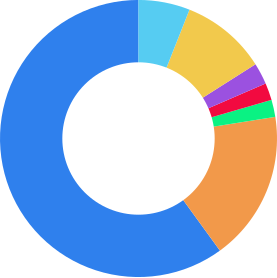
- Cost of purchasing goods - PLN 120
- Operating profit - PLN 12
- Customer discount - PLN 20
- Handling and packing of the order - PLN 5
- Cardboard, filling, tape, label - PLN 4
- Payment gateway commission - PLN 4
- Cost of acquiring a customer from advertising - PLN 35
From the initial PLN 80 margin, approximately PLN 12 of operating profit remains, from which fixed costs must be subtracted: store maintenance, hosting, software, accounting, taxes, team work, marketing tools and a warehouse. All it takes is a slight increase in CPC rates in advertising campaigns, one missed package or a product return for such an order to result in a loss.
Therefore, in e-commerce, it is not enough to ask how much the store sells. You need to know how much is left from each sale.
The trap of low margin and price competition
Stores that build their strategy solely on being the cheapest online fall into a difficult spiral. Competing on price forces margins down, while the costs of logistics, advertising, customer service, technology and campaign clicks often increase.
The low margin means that the store does not have a financial buffer for returns, damage, complaints, testing new marketing channels or periodic drops in sales. A product may sell well, but if it leaves a few zlotys after deducting costs, it is not always worth promoting it intensively.
Not every bestseller is a profitable product. Sometimes a product that has a large turnover does not make a profit. Therefore, it is worth analyzing the assortment not only in terms of popularity, but also the real margin on costs.
Technology and UX as generators of hidden costs
In e-commerce, technology is not just a tool for displaying products. It is an engine that either supports sales and optimizes costs, or generates losses that are not immediately visible in the administration panel.
Poorly selected technology may limit SEO, hinder integration, slow down the store, complicate order processing, block automation or require too many manual actions. All this affects profitability.
Mismatch between the engine and the scale of the business
The choice of an e-commerce platform is often based on the low cost of entry. This is understandable, but it can be a strategic mistake.
Cheap, random technology can generate technical debt, which over time begins to cost more than a well-selected solution from the beginning.
The most common problems are:
Lack of native integration with warehouse and courier systems, which requires manual rewriting of data,
Limited SEO possibilities, which means that the store has to make up for the lack of organic traffic with more expensive paid campaigns,
Lack of flexibility in editing the basket and checkout, which makes it difficult to improve conversions,
Difficulty expanding filters, product variants, automation or integration with sales tools,
The cost of maintaining the technology is too high in relation to the scale of sales.
The problem can cut both ways. Too simple an engine blocks development, but too extensive a tool can also reduce profitability if it requires expensive operation, implementation and maintenance that are inadequate to the store’s revenues.
The technology should be tailored to the scale of the business, team, budget and development plan. The cheapest solution is not always the cheapest in practice. The largest system is not always the best choice.
Technical problems and the cost of obtaining an order
Store performance has a direct impact on your advertising budget. If the store takes too long to load, is unreadable on a phone, or has problems in the shopping cart, the user may leave before placing an order. In practice, this means that you pay per click on the ad, but the store cannot convert this traffic into sales.
The most common technical problems that reduce profitability:
- poor results of Core Web Vitals, including LCP, CLS and INP,
- errors in the mobile version,
- slow operation of categories, product cards and basket,
- unintuitive checkout,
- no popular payment methods,
- problems with integrating deliveries or payments,
- unclear navigation and poor product filtering.
A slow or unintuitive store increases the real cost of obtaining an order. The same advertising budget results in fewer transactions, so each sale becomes more expensive.
Technical errors can drastically increase the cost of each sale
Check your store’s performance and UX before increasing your ad spend.

Marketing and marketplace pitfalls
Marketing in e-commerce must be assessed not only through the prism of sales, but primarily through the prism of profit.
A campaign may generate orders and at the same time make no business sense if it promotes products with too low a margin or has too high a customer acquisition cost.
ROAS, or return on ad spend, is a useful indicator, but it does not show the full picture. It tells you how much revenue the ad generated relative to the cost of the campaign, but excludes margin, shipping, returns, discounts, payment commissions and handling costs.
The ROAS trap and the transition to POAS
For the store owner, the real profit from the campaign should be more important than ROAS itself. POAS, i.e. profit on ad spend, is being talked about more and more often. This metric gives a better indication of whether your ad is actually making money because it relates to profit, not just revenue.
The most common problems in campaigns:
- campaigns conducted with too general phrases generate traffic that does not convert,
- promoting bestsellers with a minimal margin builds turnover, but not necessarily profit,
- the lack of division of campaigns according to product profitability makes it difficult to control the budget,
- incomplete conversion data leads to incorrect decisions about scaling campaigns,
- campaigns are optimized for revenue, not margin.
If a store doesn’t know which products are really making money, advertising can quickly start to burn through its budget.
Lack of marketing activities may reduce profitability
Lack of marketing is mainly associated with a lack of orders, but in practice it can also make it difficult to build a profitable store. If the store does not develop SEO, does not work with content, does not collect a customer base, does not conduct remarketing and does not return to users after the first visit, it must buy new traffic from scratch each time.
Acquiring a new customer is usually more expensive than reselling to someone who already knows the store. Therefore, activities such as SEO, e-mail marketing, remarketing, automation, shopping guides or recovery of abandoned carts affect not only sales, but also profitability.
When working with various stores, from small specialized e-commerce to larger stores with a wide range of products, we often see the same pattern: one-off sales work, but there is no return-to-customer system. Then the store constantly pays for new traffic, instead of using the potential of people who already know it.
Marketplace is a high-risk channel
Selling via Allegro, Amazon, Empik Marketplace or other platforms gives you quick access to customers, but you need to carefully calculate its profitability. Marketplaces can be a good additional channel, but they are not always a good foundation for the entire business.
What to watch out for:
- sales commissions and recognition costs,
- pressure of low prices,
- limited control over the relationship with the client,
- difficult to build your own customer base,
- less possibility of conducting cheap remarketing,
- dependency on the rules of an external platform.
Marketplace is someone else’s sales channel. You can generate a lot of turnover there, but you don’t always build your own brand, customer base and long-term profitability.
We often forget about this, i.e. operations, returns and basket value
E-commerce profitability often comes down to logistics, returns and the lack of a strategy to increase the value of the basket. Customer acquisition may have a similar cost – regardless of whether the customer buys a product for PLN 40 or a set for PLN 200. The difference only appears in the margin left by the order.
The most common operational problems are:
- packaging cost, i.e. materials and employee's time, not included in the product margin,
- underestimated return costs, especially in industries such as fashion, footwear or products requiring fitting,
- no up-selling and cross-selling mechanisms on the product card and in the cart,
- too low average order value,
- incorrectly set free delivery threshold,
- too frequent discounts and promotions.
The return is not only about shipping costs. It is also customer service, parcel acceptance, product inspection, re-introduction for sale, risk of damage and frozen capital. With a low margin, one return can eat up the profit from several successful orders.
Therefore, the store owner should analyze not only the number of orders, but also the average basket value, the level of returns, service costs and profitability of specific product categories.
Analytics and recovery plan
To stop guessing and start managing your profit, it is necessary to consolidate data from various sources.
Data from the store panel must be compared with advertising costs, costs of purchasing goods, data from ERP or WMS, delivery costs, payment commissions and fixed costs.
A sales report alone is not enough. A store may show revenue, advertising may show ROAS, and accounting may show costs. Only by combining this data can you see which products, channels and campaigns are really making money.
Formula for real profit from an order:
Profit =
net revenue – cost of purchasing goods – cost of logistics and packaging – payment commission – customer acquisition cost – return processing cost
Action plan for the owner
01
perform a margin audit of the entire product range and check which products generate a loss after deducting costs,
02
disable or limit advertising of products that do not have sufficient margin,
03
check the technical efficiency of the store and the quality of the purchasing process,
04
implement analytics based on margin, not just revenue,
05
analyze the discount policy, free delivery and purchase thresholds,
06
check the profitability of marketplaces separately,
07
increase the average basket value through sets, cross-selling and up-selling,
08
include the costs of returns, complaints and customer service,
09
use automation where it can reduce manual work or improve sales.
It is especially important not to scale losses. If a store doesn’t know which products and campaigns are profitable, increasing the advertising budget can only compound the problem.
Stop scaling the turnover itself. Start scaling your profit.
Let’s check which products, campaigns and sales channels really make money.

E-commerce support and profitability audits
The complexity of modern online sales means that mistakes in one area can offset successes in another. Well-placed advertising will not help if the store has a low margin.
A good offer is not enough if technology lowers conversions. There is no security in high sales if returns and operating costs eat into profits.
At Evostudio, we analyze the store not only as a website, but as an entire sales system: technology, data, advertising, SEO, UX, shopping cart, logistics and product profitability. Only such a look allows you to find places where the margin is actually running out.
If the store generates orders, but does not generate the expected profit at the end of the month, it is not worth looking for the problem by intuition. It needs to be counted.
Frequently asked questions (FAQ)
Czy wysoki ROAS gwarantuje zysk?
No. ROAS does not take into account product margin, logistics costs, discounts, returns and order processing. Therefore, a campaign can have good ROAS and not make money at the same time.
Dlaczego darmowa dostawa może szkodzić?
Free delivery is a cost incurred by the store. If it is not included in the margin or the free delivery threshold is set too low, it may reduce the profitability of orders.
Jak technologia wpływa na zysk?
A fast, stable and intuitive store increases conversions. A higher conversion means a lower cost of acquiring an order. Poorly selected technology has the opposite effect: it increases costs, limits development and reduces sales.
Czy warto sprzedawać na Allegro?
Yes, but as an additional channel and provided that profitability is accurately calculated. Basing your entire business on a marketplace is risky due to commissions, price pressure and lack of full control over the customer.
Czy audyt rentowności e-commerce można przeprowadzić zdalnie?
Yes. Technical, analytical and marketing audits can be performed remotely, based on data from the store, advertising campaigns, analytics, sales systems and operational costs.
Summary
The online store is a system of connected vessels. Focusing solely on increasing turnover is a direct path to profitability problems. Selling without profit is not a success.
It is a signal that you need to carefully check the margin, advertising costs, technology, logistics, returns, basket value and the data on the basis of which decisions are made.
Profitable e-commerce requires precise analytics, efficient technology, cost control and a marketing strategy based on profit, not just revenue. If you don’t know how much you’re really making on a single order, start by calculating your margin after cost. This is the first step to building a healthy and scalable online store.
Are you ready to improve your e-commerce results?

Author
Piotr Rompca



Get in touch and let’s see how we can help you!
Join the ranks of our satisfied customers.




