


GEO (Generative Engine Optimization) vs SEO – what’s the difference?
Author


Just a few years ago, every internet marketing specialist knew what online visibility looked like:
- positions in Google,
- clicks on organic results,
- website traffic.
Today this picture is noticeably more complicated. More and more users they don’t have to click on any link – they get a ready answer from Google AI Overviews, ChatGPT, or Perplexity.
This is where GEO comes into play: a concept that generates as much enthusiasm as controversy in the SEO industry.
We would like to introduce you to what GEO (Generative Engine Optimization) is. Does it replace SEO? Or maybe it’s just a new slogan for old practices?
What is SEO and is it still a foundation in Google?
SEO (Search Engine Optimization) is a set of activities aimed at increasing the visibility of a website in the organic (unpaid) results of traditional search engines – primarily Google, but also Bing and DuckDuckGo.
The mechanism of action is based on algorithms that analyze hundreds of signals: the site’s technical structure, content quality and relevance, backlink profile, and signals of authority and trustworthiness.
Classic SEO is based on four foundations:
Technical access
the website must be fast, crawlable (enabling search engine robots to analyze the page structure) and free from barriers for search engine robots
Content quality
unique, expert materials responding to real user intentions
Backlinks
backlinks from authoritative domains act as "votes of trust" in the PageRank algorithm
E-E-A-T
signals of experience, expertise, authority and credibility (Experience, Expertise, Authoritativeness, Trustworthiness)
SEO effects are measured by keyword positions, organic traffic and conversion rate.
The key interaction is always the same:
- the user enters a query
- clicks on the link
- lands on your website
A simple model, proven for over 25 years.
Danny Sullivan, Google Search Liaison, put it succinctly:
SEO means understanding how people search for content and then preparing content that will meet those needs. Good SEO means really good content for people
What is GEO (Generative Engine Optimization)?
GEO (Generative Engine Optimization) is the practice of optimizing content and branding so that it is cited, summarized or recommended by generative artificial intelligence systems such as Google AI Overviews, ChatGPT, Perplexity, Gemini, Bing Copilot.
Unlike SEO, the goal of GEO is not to rank high in the results list, but to become part of the response generated by AI.
The change is fundamental. In the SEO model, the user clicks on the link and visits your website. In the GEO model, the answer appears directly in the AI interface – even if the user never lands on your website, he or she can remember the brand name, quote or recommendation from it.
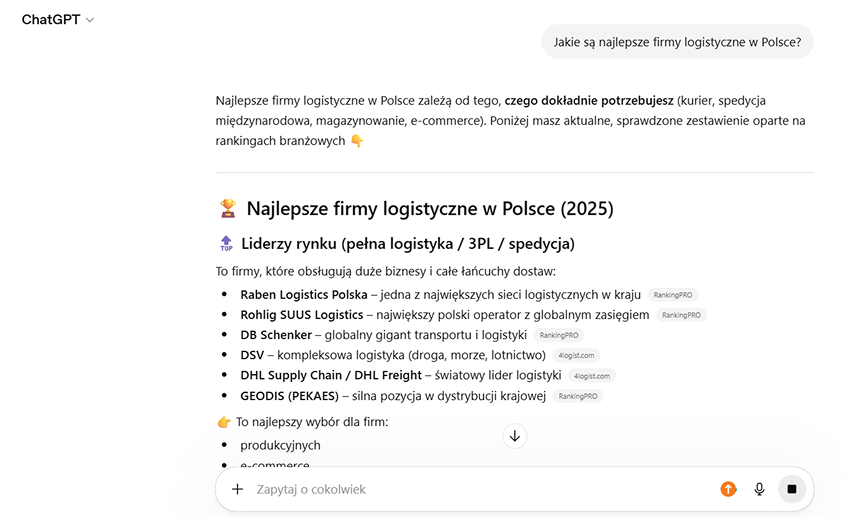
Why is GEO becoming critical today? The numbers speak for themselves:
- Between 15% and 25% of all US searches already contain AI Overviews (depending on research)
- When AI Overview appears, the first organic result loses an average of 34.5% of clicks
- ChatGPT has surpassed 800 million weekly active users
- Traffic from AI-driven search converts many times better than traditional organic traffic
There are also several synonyms for GEO in the industry: AEO (Answer Engine Optimization), LLMO (Large Language Model Optimization) and AISO (AI Search Optimization). They all refer to the same phenomenon – optimization for artificial intelligence-based search.
Do you want your company to appear in artificial intelligence recommendations?

SEO vs GEO - key differences
The differences between the two approaches are real, although not as revolutionary as some suggest.
Here are the most important ones:
| Aspekt | SEO | GEO |
|---|---|---|
| Cel | Wysoka pozycja w rankingu organicznych wynikach wyszukiwania | Pojawienie się wewnątrz odpowiedzi AI |
| Miernik sukcesu | Pozycje słów kluczowych, ruch, CTR | Cytowania, wzmianki, AI share of voice |
| Sygnały autorytetu | Linki zwrotne (backlinki) | Wzmianki brandowe - nawet bez linków |
| Typ interakcji | Krótkie zapytanie → kliknięcie w link | Konwersacyjne prompty, często bez kliknięcia |
| Gdzie budujesz obecność | Strona internetowa / Sklep internetowy | Witryna + YouTube, Reddit, LinkedIn, PR, fora |
| Format treści | Kompletność i pokrycie tematu | Akapity działające samodzielnie |
| Rola technikaliów | Crawl, szybkość, struktura strony, treści | Dostępność dla botów AI, brak heavy JS, PDF |
The biggest qualitative difference lies in the role of non-linked mentions. In classic SEO, mentioning a brand without a link has a marginal impact on visibility. In GEO, it is the textual context – even without a link – that builds the “understanding” of the brand by the language model and increases the likelihood of being cited in AI responses.
What does GEO bring new to your strategy?
If you have been doing SEO diligently for years, you already have a solid foundation. However, GEO requires several additional activities that go beyond classic positioning:
Building a multi-platform presence
AI models draw from dozens of sources. YouTube is the second most cited source in AI Overviews. Being present on these platforms is not an option, it is a necessity.
Unlinked mentions in the media and forums
Publications in the industry press and reviews on forums – even without a link to your website – increase brand recognition through AI models. It’s a change in philosophy: you stop chasing only links, you start building a textual reputation.
Content availability
AI generates answers by “cutting” fragments from various sources. Write paragraphs as self-contained units of meaning – without “as mentioned earlier” references. Each paragraph should be understandable without the context of the entire article.
Product pages and home page
Over 80% of AI traffic goes directly to product pages and homepage – not to the blog. Make sure that key subpages are not only optimized for SEO, but also describe the brand in a way that AI can easily process and quote.
Avoiding heavy JavaScript
Most AI crawlers do not render client-side JavaScript. If your content “lives” in JS – it doesn’t exist for AI. This is not new in SEO, but in the context of GEO it takes on additional importance.
PDF documents as AI sources
Language models treat PDF files as full sources of knowledge. Reports, case studies, e-books in PDF format are a great way to build authority in the eyes of AI – while traditional SEO often ignores them.
Schema markup and structured data
Structured data (Schema.org) helps both traditional search engines and AI models accurately understand and cite your content.
Where SEO and GEO are the same thing
It’s worth saying it straight: most experts – including the Ahrefs team and Danny Sullivan from Google – believe that GEO is not a revolution, but an evolution of SEO.
AI models use RAG (Retrieval-Augmented Generation) technology, which means they actively search Google and Bing in real time. If your site ranks well in traditional search, you’re already in the AI citation game.
The common foundation of both approaches is unchanged:
- High-quality content written for real users (not algorithms)
- Technical accessibility of the website to bots
- Credibility and E-E-A-T signals
- Regularly updated, fresh information
- Correct information architecture and structured data
As Ahrefs summarizes:
GEO, LLMO, AEO… it's all just SEO
The title may be new, but the rules of the game – at least in their essence – remain the same.
Does GEO (Generative Engine Optimization) replace SEO (Search Engine Optimization)?
No – GEO is an extension of SEO, not a replacement. Traditional clicks on organic results still generate a huge portion of internet traffic, and this situation will not change overnight. Moreover, OpenAI designs subsequent models as “intelligent, not encyclopedic” – which means that they will search the Internet more and more actively, and classic SEO will become an even more important foundation for visibility in AI.
The correct metaphor is not “replacement”, but a widening of the playing field. For years, SEO meant fighting for the top spot in the results list.
Now there is a new arena:
- The fight to ensure that your brand is what the AI tells the user before they even see any list of results.
Make an appointment for a free consultation

Author
Piotr Nadolny



Get in touch and let’s see how we can help you!
Join the ranks of our satisfied customers.




